Introduction to Graph Neural Networks
Graph Neural Networks (GNNs) have emerged as a powerful paradigm for machine learning on graph-structured data. Unlike traditional neural networks that operate on Euclidean data, GNNs can directly process irregular graph structures, making them essential for many real-world applications.
What are Graph Neural Networks?
Graph Neural Networks are a class of neural networks designed to operate on graph data structures. A graph $\mathcal{G} = (\mathcal{V}, \mathcal{E})$ consists of:
- Vertices $\mathcal{V}$: Nodes representing entities
- Edges $\mathcal{E}$: Connections representing relationships
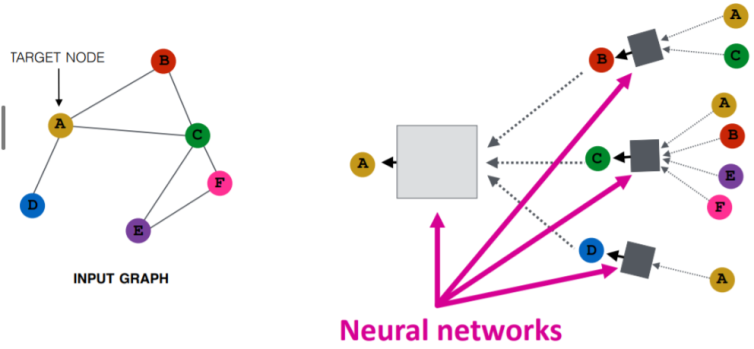
GNNs learn representations by aggregating information from neighboring nodes, enabling them to capture both local and global graph structure.
Key Concepts
Message Passing
The core idea behind GNNs is message passing, where each node aggregates information from its neighbors:
\[h_v^{(l+1)} = \text{UPDATE}^{(l)}\left(h_v^{(l)}, \text{AGGREGATE}^{(l)}\left(\{h_u^{(l)} : u \in \mathcal{N}(v)\}\right)\right)\]Where:
- $h_v^{(l)}$ is the representation of node $v$ at layer $l$
- $\mathcal{N}(v)$ represents the neighbors of node $v$
- UPDATE and AGGREGATE are learnable functions
Permutation Invariance
A fundamental property of message passing in GNNs is permutation invariance (or permutation equivariance). This property ensures that the graph representation remains consistent regardless of how nodes are ordered or labeled.
Permutation Invariance at the Graph Level
For graph-level tasks, a GNN function $f$ is permutation invariant if:
\[f(\pi \cdot G) = f(G)\]where $\pi$ is any permutation of node indices. This means that permuting the nodes of a graph should not change the graph-level representation or prediction.
Permutation Equivariance at the Node Level
For node-level tasks, GNNs exhibit permutation equivariance, meaning:
\[f(\pi \cdot G) = \pi \cdot f(G)\]If we permute the input graph, the output node representations are permuted in the same way. This ensures that node $i$ in the original graph corresponds to node $\pi(i)$ in the permuted graph’s output.
Why Permutation Invariance Matters
Graph Isomorphism: Graphs with the same structure but different node orderings should produce identical representations. This is crucial for tasks like molecular property prediction, where the same molecule can be represented with different atom orderings.
Robustness: The model’s predictions should not depend on arbitrary choices in how the graph is encoded (e.g., the order nodes are stored in memory).
Theoretical Foundation: Permutation invariance is a key property that distinguishes GNNs from other neural architectures and ensures they respect the fundamental symmetry of graph data.
Implementation Through Aggregation
Permutation invariance is achieved through the use of permutation-invariant aggregation functions in the AGGREGATE operation. Common choices include:
- Sum: $\text{AGGREGATE}(\{h_u\}) = \sum_{u \in \mathcal{N}(v)} h_u$
- Mean: $\text{AGGREGATE}(\{h_u\}) = \frac{1}{|\mathcal{N}(v)|} \sum_{u \in \mathcal{N}(v)} h_u$
- Max: $\text{AGGREGATE}(\{h_u\}) = \max_{u \in \mathcal{N}(v)} h_u$
These functions produce the same output regardless of the order in which neighbors are processed, ensuring that the message passing mechanism respects graph structure rather than node ordering.
Applications
Social Networks
- Node Classification: Predicting user attributes
- Link Prediction: Predicting future connections
- Community Detection: Identifying groups of users
Molecular Property Prediction
- Drug Discovery: Predicting molecular properties
- Chemical Reaction Prediction: Understanding chemical processes
Recommendation Systems
- Collaborative Filtering: Using user-item interaction graphs
- Content Recommendation: Leveraging content similarity graphs
Advantages and Challenges
Advantages
- Flexible Structure: Can handle irregular graph topologies
- Inductive Learning: Can generalize to unseen graph structures
- Rich Representations: Capture both node and graph-level information
Challenges
- Scalability: Computational complexity grows with graph size
- Over-smoothing: Deep GNNs may lose node-specific information
- Graph Construction: Requires careful design of graph structure
Recent Advances
Graph Transformers
Recent work has adapted transformer architectures for graphs, showing promising results in various tasks.
Graph Neural Architecture Search
Automated methods for designing GNN architectures are emerging, similar to NAS for CNNs.
Conclusion
Graph Neural Networks represent a powerful paradigm for learning from graph-structured data. As research continues to advance, we can expect GNNs to play an increasingly important role in solving complex real-world problems that involve relational data.
Further Reading
- Graph Neural Networks: A Review of Methods and Applications
- Semi-Supervised Classification with Graph Convolutional Networks
- Graph Attention Networks
This blog post provides an introduction to Graph Neural Networks. For more detailed implementations and tutorials, stay tuned for upcoming posts in our Graph Representation Learning series.